
Born in Canada from immigrant parents of mixed races and raised in a predominantly non-racialized community at the time, my experience was unique. Often the darkest in my social circles, I learned very early that I would not be easily accepted by the majority unless I left my cultures at the door. So I did.
Knowing one’s history, culture, lineage and background is powerful. Over the years, I crossed paths with many who were proud of their rich lineages. They celebrated cultural milestones and spoke of historical cultural triumphs.
Deep within me, I was sad to not know my own histories. I began to realize that I was missing a big chunk of me by placing my cultures at the door. I felt like an adopted child who never knew her biological parents, her histories, her lineages, her traditions, her heritages, her cultures and more.
Some of it was not my fault. As a great-granddaughter of slaves and indentured slaves, there is a lot I will never know. This is not just my story. This is the story of so many others.
A little over a decade ago, I began to slowly reconnect to my cultures. It seems fitting that since we are in Black History Month and I am part black, I bring in one of my inspirations. She was not a Canadian but her story as an African American inspires me.
I want to state at this juncture, you do not have to be black to relate and/or appreciate the black experience. Some of us do not know where we come from but we intuitively relate to the black culture. Some of us are part black but we don’t look it, so we are not immediately accepted. Some of us were raised in a black community but are not black. Some of us were of a different culture but were called black. Some of us were historically marginalized and/or excluded because of our cultures and/or other reasons and as a result understand the black experience. Some of us have family and/or friends who are black and we love them. Whatever the reason, just embrace it. There are many ways to relate.
The Rosa in You
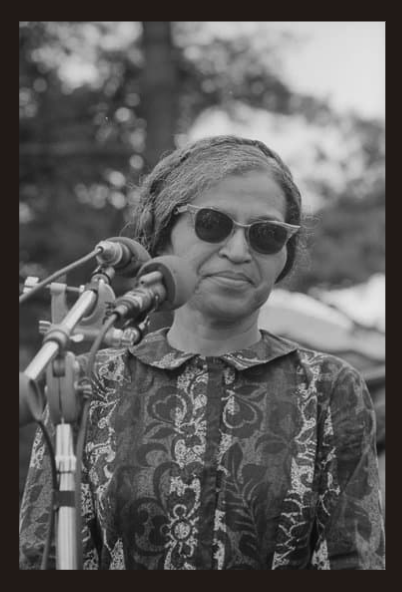
I am inspired by Rosa Parks. There is something about her. What brought her to that place that caused her to say “no”?
It was a Thursday evening, when Rosa was coming home on the city bus from a long day at work. The day was December 1, 1955. The place was Montgomery, Alabama.
Back then, front seats were reserved for white passengers, while back seats were reserved for black passengers. As the bus filled up, the bus driver told the black passengers to give up their seats. All but Rosa did.
What was going on in Rosa’s mind that day? Did she have a bad day at work? Were her feet hurting from a long day of work? Did someone yell at her prior to coming onto the bus? Was someone rude to her? Did she have enough of being mistreated? Or was she simply tired of repeatedly having to give up her seat because of the colour of her skin?
Rosa was arrested that day and eventually convicted simply because she was black.
She would appeal her conviction and many came together to support her. Martin Luther King Jr. and others united the black community and together they boycotted the city bus for 381 days all in support of justice for Rosa.
Rosa was not just challenging a conviction that was unfair, she was challenging a set of laws and a societal mindset that was unfair.
The Supreme Court of Alabama overturned Rosa’s conviction and found that the laws that separated people by colour were unconstitutional. But the societal mindset was not so accepting. Rosa lost her job and experienced harassment and death threats that caused her to move to Detroit.
As I reflect on Rosa’s experience, I am reminded of the crossroads in my life where I had to say “no”.
Sometimes the crossroads may not merge moral values and the law, meaning that the law may not yet recognize what is inherently true. Rosa was likely thinking that every person no matter their colour deserves to be treated the same and this likely led her to not give up her seat. But the laws at that time did not agree with her.
Even after the laws changed, society at that time did not agree with her and she had to move.
There is a lot to learn from the story of Rosa Parks. Her story speaks to me on a personal level as I learn my own histories. I believe that change is possible through the passage of time and with grace. I also believe that knowing one’s lineage brings wisdom, awareness and empowerment.
Whether you are on a similar path as me or you relate to this story in your own way, I hope you find a little Rosa in you.
[Post Credits: research gathered from National Geographic Kids and Encyclopedia Britannica online sources.]